- Christmas carols
- A new year of pages for my planner
- Clementines
- The quietness of 5:00 am
- Favorite holiday recipes that remind me of tradition and family
- The smell of a freshly cut Christmas tree
- Turtleneck sweaters
- Peppermint coffee
Month: December 2010
Pete
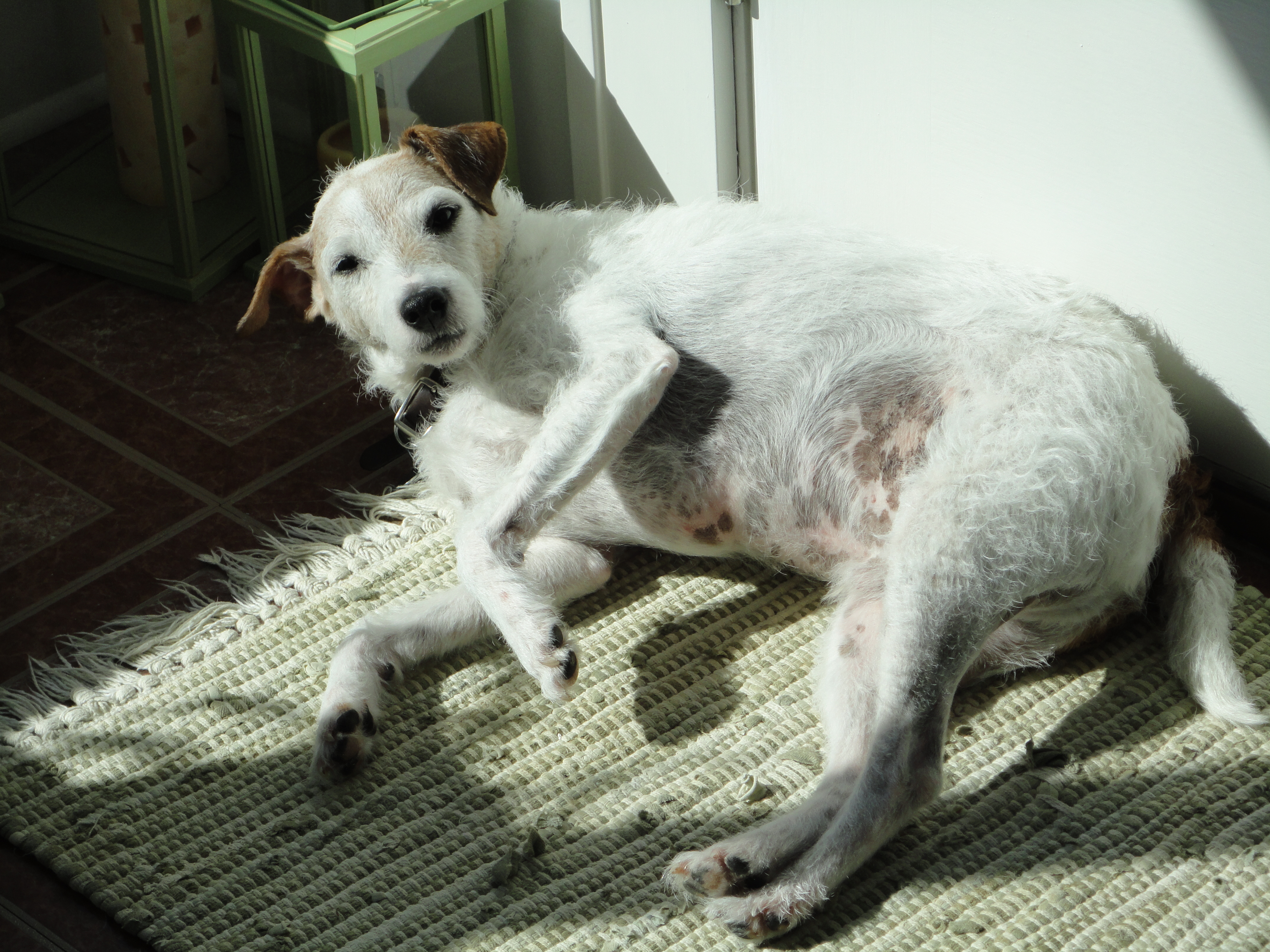 Pete sits beside me, curled underneath the throw spread across my lap. He’s my companion while I work online. A Jack Russell, almost 10 years old, he’s settled down a lot in the past couple of years, and not a moment too soon. When he first came to us, cleverly disguised as a 40th birthday present from our daughter to Rob, he was a terror. Six weeks old and cute with disarming puppy charm, he was none the less a terror. He chewed shoes, belts, carpet, and finally attacked and destroyed an upholstered sofa when he was left alone for an hour. I came home to find a trail of white upholstery stuffing scattered from the back door to the living room. I followed the trail to discover Pete, nose down, front paws digging fiercely, destroying a large part of the living room sofa. How did he survive those early days? I wanted to find a new home for him after that, but couldn’t bring myself to take him to the pound for fear that he wouldn’t find a good next owner. At least I knew we wouldn’t be unkind to him, although we were frustrated to the point of exhaustion at times.
Then there were his escape attempts. The front range foothills of Colorado are not kind to small dogs without much fur in the cold of winter. One of his first rogue excursions was almost his last. He ran up the hill above our house through the trees. There was snow on the ground, and by the time we found him, he was shivering and limping with paws that were beginning to bleed. For years, an exterior door not fully closed was all the invitation he needed to go walkabout. Or runabout. We learned to always pull doors firmly shut behind us. Except when we didn’t. He invariably took full advantage, and although I always worried that he wouldn’t find his way home, eventually I relaxed and accepted the reality that somehow, he knew where he belonged. Our son was the only one who could ever actually outrun him, and that only happened a couple of times. Typically, Pete came back when he got tired of running up and down the street, checking out everything of interest in his path.
He was a killer too, I’m sorry to say. Following his inbred instincts, he loved to hunt mice and chipmunks. We counted five kills, and my husband christened him an ace. The most memorable occasion of his hunting prowess was the time he came upstairs from our basement with a mouse tail hanging down from his mouth. He proudly dropped the mouse to show what he had done. It was not a happy revelation.
Then we moved to Alaska, and deciding to take dogs to the Arctic was no small thing. It took a lot of planning and thought to orchestrate the move with two dogs in tow. My biggest fear was that Pete would escape in the extreme Arctic winter and die of exposure before he could make it home. I wasn’t sure he would be able to identify “home.” The first year we were in the Arctic we lived in an apartment building that housed hospital employees and a lot of dogs. I didn’t know if he could identify his own home’s smell or space or whatever element says “home” to a dog in a multi-family setting. Fortunately for Pete, he only made escape attempts in warmer weather. He was smart enough to stay inside in the bitter winter temperatures.
He and Nickie, our other dog, made the RV trip with us when we left Kotzebue, living for months in the small space of a Class C Winnebago. Through the thousands of miles we traveled, he escaped a few times, but we found him after each run.
Here in Ketchikan, he has followed a familiar pattern. He has made a few exploratory trips around the neighborhood, done a little obligatory digging, chased a cat or two, and now, over the past year, has mostly settled down to being a slug dog: which means he spends most of his time curled up asleep, only occasionally rousing for an energetic burst of barking at someone walking up the sidewalk.
Pete is a snuggler, loves to burrow down under the covers at night and frequently sleeps right next to one of us. He makes a good substitute for an electric blanket. He is also in many ways a cat, curling up on the back of the sofa or the kitchen bench to sleep in the sunshine streaming in through the window. I look at photos of him from earlier years and am surprised to see how much the brown colored fur on his face has faded to a white/gray. I realize that he’s a senior dog now, although he can still jump up on the bed in a single bound.
He and Nickie, our Shetland Sheepdog who is about a year older, have what I call a “my friend the enemy” relationship. They tolerate each other, at least most of the time. Nickie, although actually a little smaller than Pete, has a ferocious temper at any feeding time, and she knows how to protect her bowl and her personal space when food is down. Pete stays out of the way and won’t even begin eating until she is finished. He is also easily cowed if caught in the act of any bad behavior…he has a conscience, and he feels badly if he has misbehaved….but likely, he will do it again if he has an opportunity.
Although Pete responds to the mom role I play with him, at heart he is really Rob’s dog. He does flips when Rob comes in, sits with him to watch TV or waits for him beside his favorite chair. He knows who the master is.
How do these little people work their way into your life so that you are willing to spend small fortunes on their food, their care, their kenneling, their transportation? I don’t have an answer for that. But for all the headache that Pete has caused, I have to admit that he has made up for the inconvenience and the expense by becoming a fun and funny dog…always eager, always ready for a belly rub, ready to jump up and see what is happening in the world outide his windows. He has made a home for himself in our hearts, and in the process, has helped to make each house a home. I think every family needs a dog. They’re especially good for bringing up children, and they’re good to have around when the children leave the nest. They help to fill the void, and reward their owners with loyalty and devotion, in the best tradition of pets and dogs.
Awakening
I have been given a great gift. I have been awakened, and I didn’t even know I was asleep.
I have awakened from a long period of taking my marriage for granted. Not that I didn’t value it…but I had forgotten how much I value it. I was asleep with nearly 30 years of acceptance, complacency, familiarity, and assumption. Not that it was always that way, of course. In the beginning, and for many years, it was different. But if time brings good things to a relationship, it can also rob it of its freshness, its excitement, the thrill of the unknown. And for all of the sweetness and joy, for all the added richness children bring, there is also a cost of time, money, and frequently, priority. The primary relationship makes room for the family. But you know the story. The children grow up, launch, move on. And while the relationships with both our son and daughter remain vital and loving, the dynamics have changed. We are two again, have been for a few years now.
Living in Alaska has been challenging in many ways. It has been exciting and an empty nest adventure, but it has also been stressful and difficult. Work, logistics, climate: they have all been stressful personally, professionally, and in this most recent location, stressful to the relationship. I find that I don’t like living alone while Rob works out of town.
How is it that I can be 50 years old and yet feel like a teenager inside? How is it that I once again find myself excited when Rob is coming home? Thinking about little things to show him that he has been missed, is loved, is appreciated with a renewed sense of anticipation and joy? It is surreal. I am in the same relationship with the same person who has been my husband and partner since 1981, and yet when we’re together now I feel 16 again. What is that about?
Separation doesn’t always lead to a good thing. Absence does not always make the heart grow fonder. But time apart can illuminate how important it is to be together. Time apart can remind you that there is someone you want to be with, that you’ve chosen to be with, that you long to be with. That is where I find myself. This past two years of living a commuter lifestyle has shown me that after all this time, I am still satisfied with the choice I made long ago. Over 30 years a lot has happened. Neither Rob nor I are the people we were…of course not! We’ve matured, aged, changed, grown, evolved into the adults we are now. I admit, looking back, the 20 year olds who got married with such naiveté were babies…how did we even have the courage to take that step at that age? I suppose the answer is that the young are fearless. Anything seems possible at 20.
Now, at 50 (alright, he’s still just 49, but who’s counting?!) we’ve had the roller coaster experience that life brings to most people: the ups and downs, good and bad. We have had our times of disillusionment, of discouragement. Without experiencing any visible tragedy, we have known the wearing down of heart that comes from the accumulated toll stress takes on the human spirit. We have reached burnout.
So we began to look for new direction, and the challenge of going through this together has awakened in me interest, excitement, hope, desire…for the future, for my partner, for myself. I feel like I’m on the brink of something amazing. But this is not just about a change of address or a change of job. This encompasses a change of heart, a renewal of commitment, the energy to focus on the partner in my life who has been with me all the way. I am hopeful and full of anticipation. And I’m 16 inside…an exciting experience for a 50 year old, and a good place to be, after all. I don’t know where life is taking us, but I’m excited to be part of the journey, and to experience it with my partner, my lover, my friend, my husband.
The view from my window
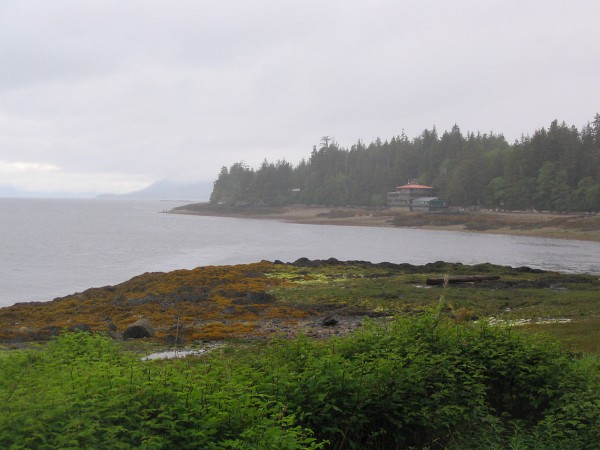 As the morning mist rises, I look out from the windows in my sunroom to the Tongass Narrows, part of Alaska’s Inside Passage. The small community of Ketchikan, AK, is built along this stretch of coast. There are low mountains all around, covered with the evergreen trees that blanket the Southeast of Alaska in forest. This time of year, early December, the tops of the mountains have a frosting of snow. Although this is Alaska, the Southeast’s climate is temperate, and rain is the most significant weather feature. The view is beautiful, a combination of nature’s serenity and the human traffic of the region: fishing boats, both recreational and commercial, barges, all types of marine vessels. And float planes, the ever-present air transporation so vital to this area. In the summer season huge cruise ships are the most prominent traffic on the water.
I have had many views from my windows in the past thirty years. I have been fortunate to live in some pristine and scenic places. Colorado was home for almost twenty years, and from the Western Slope view of the Grand Mesa and the Redlands to the majestic alpine mountains from the foothills outside of Denver, I had a front row seat to enjoy the beauty of the changing seasons. For a few years in Michigan my view was a suburban neighborhood, filled with children playing street hockey and riding bikes, a kind of ideal Americana image magically preserved from some earlier and more innocent era.
My view will be changing soon. I’m listing the house for sale in January. I don’t know what the new scenery will be, but I’m hoping that it will be beautiful. I’ll admit, I’m spoiled. Maybe this is the opportunity to have a beach view and see amazing sunsets on a daily basis. Or it might be a changing view from the windows of an RV. Whatever is in the future, I’m looking forward to the adventure and the joy of experiencing what’s next.
Cheerful vs happy
“I’m not happy. I’m cheerful. There’s a difference. A happy woman has no cares at all. A cheerful woman has cares but has learned how to deal with them.” Beverly Sills, American opera singer.
I saw this quote recently and was immediately charmed. By this definition of happiness, could anyone really claim that state? Is there really anyone who has no cares at all? Not in my experience. But I know many people who regularly demonstrate grace under fire, grace under pressure, grace in the face of real life struggles. To some degree, life is all about perspective. If things are generally good, even a small disappointment can take on greater significance. A flat tire or lost cell phone can feel like a small tragedy. I have to acknowledge that most of my life has been blessed with health, children, friends, relationships, love…the kind of life that is easy to take for granted because it is stable.
I am increasingly aware that no life is simple, that even the people around us who look whole and happy have their cares, their own quiet battles. No one escapes some form of life challenge. Sometimes the issues are of our own making, sometimes not. Sometimes the stress is personal, sometimes it is from the heartache of watching a family member or friend struggle, and only being able to stand by and watch.
So what is the answer? Even in times of stress and heartache, life goes on. How is that possible? It’s difficult to rise above grief, above loss, above pain. But the attempt to be cheerful is important. Is this just the “fake it till you make it” attitude? I think this is different. I think the message from this quote is that we acknowledge our troubles, we confront them, we choose life. We continue to embrace life. We look for the good to offset the bad.
I’ve sometimes been accused of being the proverbial ostrich, burying my head in the sand. And anyone who know me knows that I never seek confrontation with others. But I see a subtle difference here. When I have difficulty in my life, my confrontation is less with someone than with the issue itself. What can I do to make a difference? How can I overcome? After all, I can’t change another person, I can only change myself. I can only choose for myself. I can only be cheerful for myself.
I choose cheerfulness. I am not always able to claim happiness. But I can breathe deeply, I can focus on the good in my life, I can enjoy the comforts of the day: now in early December, a warm fire, a cup of hot coffee, twinkling lights, an early Christmas card from a friend. I choose to be a light in the darkness. Doesn’t mean that I don’t struggle with this at times: of course I do. But with the help of faith in the power of God, faith in the power of good, faith in the power of hope, I will be cheerful. I will overcome.
It is a very empowering place to be. I’m liking the view from this vantage point.
“Slam Poetry” – who knew?
I recently came across this YouTube video that was so stunning I had to share it. I notice it was posted three years ago, so maybe I’m the last person on the planet to see this. The piece is from the “slam poetry” genre, a type of spoken word poetry that often focuses on current issues and injustices of politics, gender, economics, etc., and can be very controversial in nature.
I am not often drawn to this type of thing, but I felt this was very powerful. The poet, Katie Makkai, doing a piece called “Pretty,” speaks about the fixation that our society, and particularly women, have with appearance. She talks of her own struggle with image and then broadens her point to include women who look for fulfillment in their latest shopping excursion, and to men who are looking for love by seeking attractiveness first. She concludes by promising her future daughter that she will never be simply “pretty” or defined by that word. It is well worth a couple of minutes to view.
I am not any ardent feminist, and I am realistic enough to know that despite humanity’s best effort and intention, people who possess personal beauty will always be counted favored and fortunate. It is certainly no crime to want to be attractive or to want to present one’s best self to the world. But the poet’s point is that for many people, beauty, attractiveness, appearance become so important that the real worth of the individual is diminished, and a false value is established: the value of how beautiful one’s face and body is, rather than the worth of the person behind the appearance.
Let me know what you think. I’m interested to know if this resonates.
New skills; or, 50 and fearless!
So, after a bit of agonizing over my inevitable 50th birthday… inevitable since I’ve continued to live…I have come to terms with my new decade. I turned 50 in September, and although I don’t want to seem totally self-absorbed, it gave me a little heartburn to realize that I’m now officially old enough for an AARP membership.
I’ve heard some women speak of being “50 and fabulous,” and while that’s a line I’d love to claim for myself, I can’t honestly say that I’m fabulous on a daily basis. My fabulous moments are somewhat hit and miss. Most of the time I have to categorize myself more in the “doing the best I can” mode.
My new phrase that celebrates turning 50 and showcases the spirit I’m striving for is “50 and fearless.” This is not to say that there are not plenty of things in life worthy of fear. Serious illness, loss, concerns about family, relationship issues, money troubles, the leak in my bathroom…all bring some level of fear to my mind. Some fears are easily calmed, and anything that can be resolved with money, in my opinion, is not too big a problem in the first place. It’s only money, right? But some fears are too real, too big, to gloss over with a pep talk. Some things can’t be bought with money. Some things have to be accepted, acknowledged, lived with.
But the attitude…that’s what I want. The spirit of fearlessness is my goal. The spirit that says “bring it on, I’ll find a way to meet this challenge with grace and dignity.” And if I can nurture that attitude in myself, if I can face life with boldness, then maybe turning 50 will be ok after all. It feels a bit like arriving, although I don’t claim to have everything figured out. But by this point in my life, I’ve lived long enough to know that whatever comes, most likely the process of finding a solution to a problem, or finding the grace to accept, will stretch me in new ways, will broaden my horizons, will bring new insight. And after all, isn’t that valuable in itself? I know more, and less, now than I did at 20. I am more confident and more tolerant, less sure that I have the answers to everything. But I believe I am kinder, gentler, softer, and yet have more ability to endure. And as I take stock of myself at the beginning of this new decade, I’d like to believe I’m progressing, not just aging.
So that’s my goal and challenge to myself: to be 50 and fearless. To be courageous and to embrace whatever comes; to seek the opportunity to grow, to stretch, to find new strengths, new skills, new horizons. And who knows? Maybe one day I will be fabulous as well as fearless…with a lot of effort, and a generous supply of grace.
 Grace and Life
