How do you work?

“When you play, play hard; when you work, don’t play at all.”

“Whenever you are asked if you can do a job, tell ’em, ‘Certainly I can!’ Then get busy and find out how to do it.”

“The most important single ingredient in the formula of success is knowing how to get along with people.” ~ Theodore Roosevelt

I’m leaving the position I’ve had the past 2 1/2 years for another job within the hospital. It’s bittersweet for me, because although I think this is the right move for me, given our plans to sell the house and eventually move away from Ketchikan, the reality is that hasn’t happened yet. I am leaving a great group of people who have become friends as well as co-workers, and I’ll miss them. But this move takes pressure off filling my position at short notice. The right person came along and we all agreed this was the thing to do.

It has made me think a bit about my work life. I’ve been fortunate to have a partner who does the heavy lifting when it comes to income. I’ve worked to pay for some extras, to cover kid camps and family gifts, the niceties of life. Oh, I pay for groceries and I cover car payments, but Rob has paid the big bills. So although I’ve worked very steadily, my positions have been job oriented rather than career focused. But that has also allowed me to be in some unique and enjoyable roles through my work life. I’ve done event planning for the Chamber of Commerce in Midland, MI; worked for a decade for a small map company in Evergreen, CO, that was eventually bought by National Geographic; spent the past five years here in Alaska in the field of healthcare administration, learning the world of hospitals, physicians, meetings, acronyms like alphabet soup; spent some time substitute teaching from kindergarten to high school; and even had a role in HR in one of my earlier jobs. I’ve had variety and I’ve always landed among good people that allowed me to try, to experiment, and to (mostly) succeed. Not bad for a liberal arts degree from long ago!

I like the quotes above because I think they speak to the fundamentals that make for a successful work life. The first one is pretty clear: get the job done. Alright, I’ll admit that sometimes laughter erupts during a meeting at work. That’s ok, even good. But the focus is on the job. Get work done at work and play time will take care of itself.

The second quote is really foundational to the way I’ve moved through my various job scenarios. Of course this philosophy only goes so far…you can’t bluff your way into doing surgery, or flying a plane, or many other things. But if you have basic skills and a can-do spirit, many doors will open to you. I’ve been so fortunate to work in environments that have stretched me, given me need and incentive to learn new software, new tools, new words, to reach beyond the knowledge I brought with me to the position of the moment. Each job I’ve had has given me unique perspective and abilities that I’ve then been able to use in later settings. Nothing is lost along the way if you make the most of the opportunities as they present themselves.

And in proper order, the best is the last: getting along with people is THE key to everything: personal life, work life, social life…each world is a part of our larger universe, and each world is filled with people. And some will make you laugh and just be glad you’re living. Others will make you crazy. Your job is to learn to navigate and to work with whoever is in your path. That’s what ultimately gives success. Success is measured in financial gain, but more importantly, it is measured in ways that can’t be measured. It’s the human touch, the encouragement you give, the smile you share.

If you work full time, you spend a lot of your life and your energy in that setting. Here’s hoping that you’ve found your own secret to success, and that you have a work philosophy that works for you.

Who knows what’s next for me? I’ll be here for a while yet, waiting on the sale of the house. But when I move on, I’ll take the skills I acquired here and the experience, add it to the rest of the knowledge I’ve accumulated, and be off to see what new life adventure is waiting for me. Chances are, I won’t be doing anything that requires a lot of math or conflict management. But whatever I’m doing, I expect to enjoy it, broaden myself a bit, and keep my people skills fresh.

Here comes the bride!

The Fairytale

It’s summer, the bridal season: the most popular time of year for weddings. I was looking through a Bride magazine a few days ago, waiting in the check-out line in the grocery, and a beautiful dress caught my eye. No, I’m not in the market for a wedding dress. I got married almost 30 years ago. My daughter got married five years ago, and she had a beautiful gown. She doesn’t need another. Hopefully the marriage she’s in will last her.

But though I’m not shopping for a dress, I couldn’t resist looking closer at the classic and elegant fairytale image on the magazine rack. And why is that? Does the dress make the event? Is it really the show-stopper? Yes. We all want the fairytale, and the dress, the big wedding, the traditions, the special touches all combine to convince us: this will last. This is true love.

I’ve had a plethora of relationship issues swirling about me in the past few months. Multiple couples in my life, at various ages and stages of relationships, are in trouble. I don’t want to oversimplify, and there’s no one fix for all. But as I was venting about one of these situations last weekend with Rob, he suddenly smiled and said that it would be more appropriate if couples got married in construction work clothes rather than fancy dress; more true to life if the bride and groom carried tools to symbolize the never-ceasing work required to build a marriage, rather than the classic bouquet and boutonniere.

I had to smile at the thought too. Imagine, instead of the fairytale scene of an outdoor wedding on a June day, or the symbolism of ancient traditions in a church, imagine you attended a wedding all dressed up in your finest Saturday paint clothes, or the outfit you choose for yard work? What if you and the others who attend the wedding to show support and love for the couple came armed with all sorts of items to help with the daily chores of life and marriage? Cleaning supplies, budget programs, self-help books, counseling resources, babysitters? What if each couple standing up to share their vows faced a sea of people visibly committed to supporting the marriage in good times and bad, with practical, emotional, spiritual and physical assistance?

Well, it would be symbolic, that’s for sure. I understand that in fact, many couples do receive support from family and friends, and many enter marriage at an older age and with more life experience under their belts. I know that wearing one costume or another doesn’t guarantee the degree of sincerity or the ability to stick with a hard situation, through difficult times. But I think that it might make a striking impression on everyone involved if there was a visual demonstration of the work a couple commits to with their exchange of vows.

I thought about the reality of that scene for a few moments…no, it would never fly. Most brides, or mothers of brides, want the photos, the memories, the big event. And I understand that. That’s what I had, what I wanted. So I came up with a compromise concept.

Here’s my proposal: Just like the work of preparing for a party comes before the actual party, so the symbolic work of getting married should come before the celebration of getting married. The wedding would be a two-part event: the couple invites guests to join them for the ceremony and the dress code is work clothes, the grubbier, the better. Each guest is invited to bring something to symbolize a part of marriage and family. The couple shares their vows, and then there is a short break for guests and the bridal party to move on to the second stage of the wedding: the fairy tale. This re-staging of the marriage vows, complete with bridal pomp and circumstance, is the celebration and the photo-op that is the wedding portrait.

Yes, a bit cumbersome to go through a double event to commemorate a marriage. But after all, if it’s really supposed to last a lifetime, surely an extra hour or two is worth it? And what better way to impress upon bride and groom, as well as family and friends, that the foundation of marriage takes work and effort, from the very beginning? The fairytale is important too, because it symbolizes the part we all hope for: the happily-ever-after, the beautiful bride, the handsome groom, the perfect scene.

I don’t mean to imply that anyone going through relationship difficulties hasn’t tried hard enough or worked at making things work. I know a lot of people do their very best, but that doesn’t always equal happiness or the ability to last. No relationship is fail-proof. I’ve had experience of that myself: my relationship has had it’s ups and downs, some of them severe. I know a bit about difficulties, and about overcoming.

Well, this probably won’t be the new cutting edge in weddings…too involved. But maybe the next time you’re invited to a wedding, along with the traditional gift of china or crystal, linens or kitchen appliance, you can add a practical tool or two to send the message: it’s work. It’s hard work. But don’t be afraid of it. Like most things that require hard work, making a marriage out of a wedding takes energy, creativity, passion, determination, selfless giving, and a lot of luck. But the result will be worth it. So worth it.

Photo from here

What would you do in six months?

My husband was reading a book recently that referenced a woman who routinely considers what she would do if she only had six months left to live. Of course, if you absolutely knew you only had six months, there would be some things that would be doable that you would never actually do, outside of a mental exercise. Unless I knew, I wouldn’t quit work. I wouldn’t use all my savings, either on travel or kids or good causes. I wouldn’t drop my health insurance, or skip making my next dental cleaning appointment.

But what would I do if I knew? I’m not sure I can define a timeline…how do you determine how much time out of a six month window is enough? Enough time with your spouse, your children, your grandchild, your family? How much time would I want for myself? I think there are a few places in the world I would want to see with Rob at my side. There are some friends I would want to connect with, in person. I would want to be deliberate and intentional in my choices, in how I spent my time.

Would it be possible to use each moment wisely? And what would I want to leave as a legacy? I want my children to know I am a woman of faith: faith in God, faith in them, faith in life. Life isn’t always fair, pretty, or happy. But it is wonderful, full of surprises. I’ve learned not to write the end of the story before its time, because the ending I think I see is probably not the end that will ultimately be. And so I’ve learned that it is worthwhile to watch and to wait.

There’s a quote I like from Divine Secrets of the YaYa Sisterhood, a movie about a dysfunctional family and a daughter coming to terms with the impact of the dysfunction in her life. In one scene she is with her dad, and she asks him, “Daddy, did you get loved enough?” And I think that’s the question I would ask the people I love. I know how I feel about each one. But I would want to be sure that each one knew, from me, in my words, how I love them.

This isn’t really a morbid thing to do. I actually found it enjoyable to think about what is most important to me; about who is most important.

I’m not experiencing end-of-life premonitions, nor do I expect to lose my house to a fire, if you read my previous post. I’m really in a good place. But I am 50, and several people have mentioned to me that this was a year in their lives of introspection, contemplation, and re-discovery. I don’t think I’m naval-gazing…I like to think I’m cleaning out and re-setting myself. It’s good to evaluate and get re-acquainted after years of “keeping milk in the house.”

So, if you’re up for some introspection, right after you finish contemplating what you would save if your house was on fire (see yesterday’s post), give some thought to what you would do in your last six months. Or play with the formula…give yourself a year, shorten the time frame…it can be your exercise to design as you choose. I think it’s worthwhile to consider. Just don’t get carried away and turn in your resignation. Chances are you’ll be around far beyond the time you allot yourself!

Skydiving

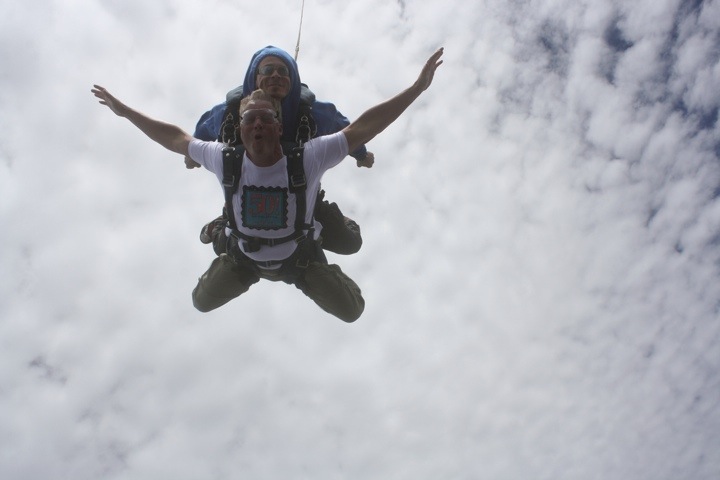
Yes, we really did it. Rob and I did a tandem sky dive jump on his 50th birthday. I wasn’t nervous until about five seconds before we jumped. We were both hooked to a professional jumper who was in charge of the hard part…pulling the chute, making sure we survived the adventure, and most important, keeping us (alright, me) from panic and any resulting hysteria.

The whole thing was surprisingly simple. Signing the release forms took a lot longer than the very brief instruction for a successful tandem jump. There were three main directives: first, you arch your back when you are in free fall; second, remember to breathe; and third, once the chute is opened, you can open your arms and stretch into the wind. That’s it. That’s all you need to know to jump out of a plane.

The short flight up to 13,000 feet was fun, sitting on a crowded bench with fellow jumpers. Most of the group was jumping without benefit of a professional attachment, which I didn’t really appreciate until I was standing looking out of the open door, staring into the air, faaarrr above the ground. I was just starting to say out loud, “I don’t think I can do this,” when I suddenly realized that I was HOOKED to this person I had paid to jump with me, and HE WAS GOING OUT THE DOOR. Obviously, that is a critical part of the experience. I would have been too paralyzed to jump if I had not been attached to another person who made it impossible for me to stay inside the plane.

As soon as we were out the door (didn’t see the first several seconds, my eyes were too tightly shut) I focused on breathing and holding the arched position that was required for the free fall. About the time I was opening my eyes I felt the chute open and the whole experience went into a sort of slow motion. It was beautiful and smooth, and I left the fear way above me, in the space just outside the door of the plane. The instructor gave me a little flight-seeing tour, pointing out different landmarks above San Diego and taking us through a series of gentle turns as we floated toward the landing area.

Would I do it again? I doubt it…not that I couldn’t, but I think it will be a once-in-a-lifetime experience for me. Once was enough.

And what did I learn? It was an amazing illustration of the power of connection, of having someone to push me beyond my comfort zone, and then to create a soft landing from a beginning that was frightening.

I thought of how often life is like that: two people connect themselves to each other, and at any given moment may switch out the roles of the professional leading the way and the novice along for the ride. Each person brings their expertise and their courage to the experience, and together, if the jump is successful, they navigate to solid ground and land right side up, feet first, in spite of having times of being upside down on the trip down.

Maybe I’m reaching in my analogy…but it seemed perfect to me. Life sometimes seems upside down, like I’ve jumped out of the plane and am looking for the landing zone. Sometimes I’m in the free fall zone, and sometimes I’m in the peaceful and inspiring space of floating, taking it all in. The key is the jump buddy I’m attached to. Well, it’s an interesting ride, and sometimes unpredictable. But I’m with the same buddy I’ve had for almost 30 years, and I haven’t crashed yet. Must be doing something right.

Here’s to jumping out, taking the plunge, and careful selection of your jumping partner. It makes all the difference when you’re standing at the door, looking out. Be sure you’re strapped on tight, and that you’re connected to someone who will be good for the ride! It’s an amazing experience, but the most important choice is the one you make before you leave the ground. It’s the choice of the jump buddy.

20110608-121852.jpg

Training for transition

20110607-111518.jpg

I’m training my replacement at work. By mutual agreement, I am transitioning to another position in the hospital, one that I will hold until the house sells and we leave Ketchikan. I feel good that this will be a smooth way to move from my current role and still maintain income and benefits. But it’s bringing home the reality of the disconnection process. I’ll be stepping away from some fun (and funny) co-workers who have been good to me, helped me grow, and have been unfailingly kind as Rob and I have been on a merry-go-round of sorting out our lives and next steps.

I didn’t begin my work life in a hospital environment, and in fact, only transitioned to that about five years ago, using a variety of administrative and general office skills to fill an office role in the hospital in Kotzebue, AK. Then, because of that work experience, I was hired for an administrative role here in the Ketchikan hospital. The work is diverse, and although there are some tasks that come around on a regular basis, it never gets boring.

I’m fortunate to have an inside track to understand the complex world of healthcare and medicine in 2011. And of course, I understand almost nothing at a clinical level, since I’m averse to things like blood and needles. And how is it that I work in a hospital at all, you may ask. Well, there is a surprising amount of work that goes on in healthcare environments that has little to do with medicine, and everything to do with the business of medicine. And that’s the side of healthcare that I sit on.

I work for PeaceHealth, a Catholic hospital system that has a core mission of service. I see regular instances of selfless giving. It’s not all about money. I also see the burden that modern medicine, societal expectations, long hours, thin staffing, and a challenging and isolated environment imposes on providers and staff. I hear the comments that physicians make in meetings, see the lifestyle of long clinic days, nights and weekends impacted by call, and recognize anew: it’s a difficult profession.

And what is the point of this to me? It’s given me a view of Rob’s world that I never had before, and helped me to grasp, in a very real way, the issues that he faces on a regular basis. One of my tasks in my current job is managing the primary care call calendar, and I understand the impact of call in a small clinic practice. I hear the talk, I understand the issues, in a way that I could not have understood in the past.

And has it made a difference? I think maybe it has.

I understand a lot more than I did when I moved to Alaska, almost five years ago. It’s been a long road, and I’m not sure what my work life will be like in the future. But I hope I’ll be able to hold on to the realizations I’ve come to, and the insight into my husband and my marriage as both have been shaped by the profession of medicine. It is consuming, almost all-consuming, and I don’t think it is an exaggeration to say that we would be very different people if Rob had chosen a different profession.

I know that it isn’t possible for most people to enter into the work life of a spouse, boyfriend or girlfriend. But if you can, even if it’s just for a short while, or in a limited way, it may change your perceptions. And isn’t that what we all need? We want to be understood, to know that the person we share a life with can understand, can empathize. If you could see what I see, know what I know…

Birthdays

Happy Birthday!

We recently celebrated Riley’s first birthday. On June 1, Rob will turn 50, and my grandmother will turn 90. I think about the span of these years, almost a hundred years between Riley and her great-great grandmother. Rob is right in the middle. Funny how at the early ages, each year is so eagerly anticipated, and at our point in life, the number becomes something to be joked about, maybe secretly feared, but as much dreaded as celebrated.

Well, I’m all done with that. I can’t turn the clock back, and I don’t even want to. Oh, I wouldn’t mind a discreet nip and tuck in a couple of places, but other than being in need of a bit of cosmetic touch up, I’m beginning to appreciate this stage of life in ways I never anticipated.

I know my skills, my strengths, my good points, my faults. I accept myself, although I am still (as always) seeking to improve. Acceptance doesn’t equal indifference. It just means that I try, fail, try again, and keep smiling.

But perhaps more important, I accept others. Acceptance doesn’t equal approval. But my role in life is not to go about approving of others. My job is to become my best self, and to meet others where they are. My job is to lighten the load where I can, to be salt and light where I can. To bring comfort where I can.

Each of us has a circle of influence and a circle of people we impact. In the sea of humanity, my circle is quite small. My place in life is small. But I can choose to be of value to those in my life. And that’s my goal. I’m excited to have the freedom and flexibility in my life to give, to share, to nurture, to extend myself. At 50, that’s what I celebrate.

At one time, I thought my heart was breaking. But now I find it was breaking open. And that’s a good thing to know, at the ripe old age of 50.

Happy birthday to the lucky ones that have birthdays on the horizon. I’ll never dread another one. That’s a promise I’m making to myself this very day. And if I’m fortunate enough to have my grandmother’s longevity, I’ll count my wrinkles and my days with joy.

Hope

From my collection of quotes, declarations of hope:

I believe that imagination is stronger than knowledge. That myth is more potent than history. That dreams are more powerful than facts. That hope always triumphs over experience. That laughter is the only cure for grief. And I believe that love is stronger than death.        Robert Fulghum

The natural flights of the human mind are not from pleasure to pleasure, but from hope to hope.   Samuel Johnson

Expect to have hope rekindled. Expect your prayers to be answered in wondrous ways. The dry seasons in life do not last. The spring rains will come again.  Sarah Ban Breathnach

All the great things are simple, and many can be expressed in a single word: freedom, justice, honor, duty, mercy, hope.  Winston Churchill

I cannot believe that the inscrutable universe turns on an axis of suffering; surely the strange beauty of the world must somewhere rest on pure joy!           Louise Bogan

Hope is like a road in the country; there was never a road, but when many people walk on it, the road comes into existence.    Lin Yutang

If you want to build a ship, don’t herd people together to collect wood and don’t assign them tasks and work, but rather teach them to long for the endless immensity of the sea.                  Antoine de Saint-Exupery

The Grand essentials of happiness are: something to do, something to love, and something to hope for.         Allan K. Chalmers

You must not lose faith in humanity. Humanity is an ocean; if a few drops of the ocean are dirty, the ocean does not become dirty.        Mohandas K. Gandhi

Some people believe that  having an attitude of hope is a way to practice self-deception, to hide from reality. But I disagree. I think hope is what fuels inspiration, strengthens resolve, helps us to hold on when we doubt. Hope is not a mind-numbing drug. It is an affirmation that though our wishes don’t always come true, they often do. Sometimes our own faith in the outcome is what makes the difference. We all have the ability to be self-fulfilling prophecies. I choose to live on the hopeful side of life.

Spring is sometimes called the season of hope. But hope isn’t limited to a time of year, or a time in life. It can flourish at any time.

What are you hoping for?

Getting to know myself

In the past few years, post kids in the house, I’ve had more time for myself. In some ways, with work, travel, new projects, my days seem as full as ever. But there has been a shift in the busy-ness of my free time. Now I’m more likely to spend time reading online, or exploring some new activity for myself. Not that I’m totally self-absorbed. No, there are others in my life, and I reach out in many ways. But in the quiet of the evenings, or early mornings, I have freedom that couldn’t exist in the years of getting kids out the door for school, or doing laundry for a family, or proof-reading term papers due the next day.

I read other women’s work and at times, feel like I’m a late bloomer, or maybe just incredibly slow on the journey of self-discovery. There are women in their 30s that seem to be more enlightened about themselves, and more experienced in some ways, than I am. How can that be? And then I remember. I was busy that decade of my life. And in my 20s. And until late 40s. Not that motherhood and family prevent self-examination, or stunt personal growth. No, in many ways, parenting is a never-ending growth opportunity and personal challenge. It has made me want to be the best “me” I can be, and for the best motives. But it takes tremendous commitment and focus. And maybe I’m not as much a multi-tasker as I like to think.

I began the experience of motherhood at a young age. At twenty-three, just out of college a year and still a baby myself, I had a baby. And suddenly that consumed my world. In many ways, because my husband was equally consumed with medical school, it became my salvation. I was so absorbed with this new person in my life that I wasn’t troubled by the pattern our lives fell into. We each committed to our assigned roles (roles we assumed and accepted without discussion or question) and put our heads down to power through the next several years of life, surviving professional school, residency, another child, moves, stress, minimum income, minimum time together. Looking back, it is nothing short of a miracle that our marriage survived and that we were able to create a functional and even positive environment for our children. Somehow we did it. Now I understand that there was a cost, and we paid a price. We paid a price personally, and jointly. But at the time, we were just doing what was expected of us. What we expected of ourselves. Failure wasn’t an option.

As our children grew and I took on work, first part time, then full time, and Rob moved through various stages of a career in medicine; as the obligations and responsibilities of family and social commitments, volunteer positions and the chores of life grew to be never ending, we soldiered on. Now, with the benefit of hindsight, I realize that for all of the thought and care that I put into those years, there were pieces of myself that were dormant, just waiting to breathe, to have opportunity to surface.

Let me validate, for myself and for anyone else who cares to know, that those years were good. Reduced to a few paragraphs in blunt language, it’s easy to miss the joy, the love, the laughter, the good stuff. So let me acknowledge: it was mostly good. But it was busy, overwhelming, consuming, challenging. Fill in the blank with whatever word conveys the sense of completeness. The reality of life is: if you jump into the pool of creating a family, it’s going to consume you. It may consume you with joy or with grief, with busy-ness or guilt, but it will consume you. You can’t really dabble in it. If you do it well and successfully, that takes time. And if you do it poorly, there’s a cost to that too.

So what’s the point of all of this? The point is: I did it. We did it. We made it through to the other side. I always say if you have children, you’re going to pay the price either early or late. It’s not a question of the value of the decision to parent. That statement simply acknowledges the commitment. And the hands on commitment, whether you begin at twenty-three or forty-three, is going to take time, energy, money, thought, self.

Now I’m in a different time of life. I’ve written before about the empty nest, about growing into it, accepting, coming to celebrate it. The emotional ties with our kids are strong. The effort to be connected still takes time and thought, energy and commitment. I still spend money on our kids. Of course I do. They didn’t exit my life when they went off to college, or joined the army, or got married, or began to earn enough that they didn’t need regular rescue checks. But the hands on tasks are largely done. And that has left room in my days for self-discovery, for quietness, for thought. It’s amazing how much time you need to think and absorb.

I don’t know how I stack up against others. Maybe I am slow. Or maybe some of the writing that I read online that speaks of a self-knowledge gained at an earlier time in life is possible because the women writing have taken different paths than I did. Maybe they found themselves first, and will add family later, if at all. And I’m not saying that personal epiphanies and family are mutually exclusive. I had moments of enlightenment even when up to my armpits in the lives of my kids. I learned to do many things because of them, and through them.  But it’s easier to get to know myself without the noise of a full house.

So I’m working on it. Some parts of me I’m well acquainted with, but there are nooks and crannies that I’ve hardly looked into. I’m exploring, both to see what I’ve neglected or forgotten about myself, and to learn what I can contribute to the rest of the world. Because really, the point is not to do all this growing just for my benefit. Isn’t the goal to integrate, to give, to share, to take part in the lives of others? Yes, that’s the goal. And to do that, I have to know what I bring. I’m late (those who know me will hardly find that surprising…one of my faults…I’m chronically late). But I had a great reason for my slow start, and I don’t regret it. I was investing up front. Now it’s time to catch up, and I’m ready to do that.

Where are you? Did you begin early, or late, to know yourself?

Reality check

I went for a little ride yesterday. No, I wasn’t at Disneyland or driving some stretch of highway. I was lying on a table in the ultrasound room of the Women’s Imaging Center, waiting for the results of a breast exam. It was a long half hour.

I had a mammogram a few weeks ago, just a routine screening. I got a call on my cell from my gynecologist’s office while I was in Arizona for Riley’s birthday. I needed to come back for a follow up. The radiologist had requested “more views.”

“This happens all the time,” the woman on the phone said. “They just like to be sure they haven’t missed anything.” Well, I was in baby mode, birthday mode, and it was comforting to accept that opinion. I didn’t lose any sleep over it, but I did make an appointment to have the second screening when I got back to Ketchikan.

I went downstairs for the second mammogram yesterday morning. Fortunately for my peace of mind, the radiologist read the images right away. She was still not quite satisfied, and recommended the next step, a breast ultrasound. I agreed; better to be safe than sorry. Since I work in the hospital, I asked the person scheduling to work me in whenever she had an opening. It might be a few days, but she assured me she would do that.

Two hours later I got a call. Could I come down at 2:30? Yes, I was happy to get this done, get it out of the way. A little voice in my head wondered if this was really just a sudden opening, or if there was something the radiologist had seen that pushed me up in the urgent queue? I hadn’t picked up on any concern. But isn’t that the job of professionals? Don’t alarm the patient. Remain calm. And after all, they do this every day. I’m the novice. I can still count on one hand the number of mammograms I’ve had.

The staff in the imaging clinic is extremely nice. I am polite and calm as I check in. The gowns are warmed. The lighting is soft.  No one is excited here, we all know this is just routine. If they don’t seem alarmed, why should I? I could have taken a nap during the ultrasound, except that it’s a bit difficult to relax with gel on your breasts and questions going through your mind every time the tech lingers over a specific spot. What does she see? Why is she slowing down? I know it’s not appropriate to ask the technician to tell me what she thinks. Although I’m sure anyone in that role has enough knowledge to recognize an abnormal tissue mass, it is not the tech’s responsibility to discuss findings with the patient. So I resist the urge to pepper her with questions. I’m a model patient, shifting and adjusting as she completes the test.

Again, the radiologist will read the views right away. And again I wonder: is that normal, or do they seem something that requires urgency? The tech steps out of the room to confer with the doctor, and I’m left to stare at the ceiling and question.

I think the things that I assume most women think: this will be fine. Nothing to see here. I comfort myself. I don’t have a family history of breast cancer. I feel fine. I’m only 50! (Cliché alert: as they say, it looks younger every day!)

Then, for just a moment, I allow myself to imagine. This is how it starts sometimes. Just a routine exam, a little question, another test. And then, something definite. A diagnosis is made. Suddenly the lists are not about errands or chores, they are about appointments, tests, surgery, follow up, treatment. I watched my dad go down this path with colon cancer. I’ve seen others go through this. Why do I think I’m immune from this possibility? Why do any of us think the age old “it won’t happen to me?” I already know the end of the story. I know someday I’ll die of something. But I’m only 50! And that eventual reality is comfortably distant, isn’t it?

I think about the times in life that have focused me: the birth of my children, the loss of a loved one. Or on rare occasions, the poignant moments that stand out, that are frozen in my memory: the good stuff. Why, I ask myself, why can’t I keep the truly important things at the top of the list? Why do they always slip down below the urgent? Why is so much of life about keeping milk in the house?

Maybe we aren’t built to stand the intensity of the deepest emotion, the pinnacle experiences, on a 24/7 basis. They’re intense, these times of insight. They’re beautiful, magical. But intense. Who could live at that level all the time? And maybe, the very fact of routine in life is what keeps the magic in the other moments.

It seemed like a long time the tech was out of the room. Maybe it wasn’t. I was just rounding the corner of all of this in my mind when the door opened. “Ok, just keep up with your scheduled screenings. Looks good.” She smiled and opened the door for me. I went back to the dressing room to change, reassured and feeling vindicated that I had known I was fine all along. Nothing to see here.

Yes, it was all routine. Except for those few minutes on the exam table. They were a sharp reminder of what’s important in life. Funny how the extremes, good or bad, wonderful or frightening, can have the same effect. I left the clinic and walked back to my office, smiling, thankful that this wasn’t the day to switch out my lists. I have to remember to pick up milk on the way home, and the dry cleaning, not schedule a surgery.

Too late to apologize

There’s a song I hear on the radio, “Apologize.” The chorus says “it’s too late to apologize.” I wonder if that’s really true. It can be too late for apology to repair, but I think as long as there is life, there is opportunity to apologize. Maybe, in the end, an apology is just words, and if there is no power in the words to bring healing or resolution, then the apology is meaningless?

But I don’t think so. Some hurts may not be healed with words, but that doesn’t mean that the words are not important. Validation is important, and isn’t that what saying “I’m sorry” is really about? One person saying to another, “You were right, and I was wrong. I didn’t see before, but now I do.” Or in the words of the immortal song, “I once was blind, but now I see.”

Words are only words. But they are powerful, none the less. An apology is a beginning, or maybe an ending. But most of all, it is acknowledgement. Saying the words can be cleansing and healing for the person saying them. And after all, if you have an apology to make, you can do your part. But you can’t choose how it will be received or if the words will have ability to change the situation. That is for the person receiving the apology to determine.

Some lessons are long to learn. I used to think that if I stepped up, admitted I was wrong, said the right words, was sincere, then of course all would be forgiven. But it doesn’t work like that, at least not all the time. Now my realization is this: just as giving an apology doesn’t guarantee that the receiver will accept it, rejection of apology doesn’t change the fact that it was given. And that it is meaningful, even if only to the person saying “I’m sorry.”